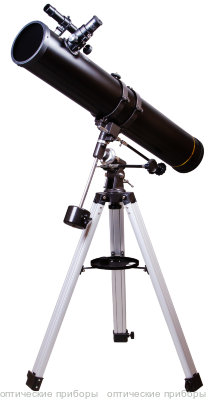
|
The instrument is subject to continuous
development and improvement, consequently it may incorporate minor changes
in detail from the information contained herein.
ATTENTION!
The telescope forms the inverted image
like any astronomical instrument does. The direct observations of the Sun through
the black light filter are permitted only with the use of the solar diaphragm.
1. General directions
The telescope is designed for visual observation of the
celestial objects.
The telescope can operate normally at the ambient temperature
from 30°C to minus 30°C.
When buying the telescope one should pay attention to
the package safety ensured by the seal of the manufacturing pliant. After
unsealing the case one should check compliance of the complete set denoted
in the list of enclosure. Prior to using the telescope one gets acquainted
with its handling and order off operation,
Telescope is completed with additional reticle with cross
for eyepiece F=25mm. User can adjust an optical axes parallelism of telescope
tube and finderscope.
3. Delivery set
The composition of the telescope and its delivery set
are shown in the table.
Telescope 5.803.040 1
Finderscope 6x 5.920.019 1
PlossI eyepiece of f'=25 mm. 1.25" 5.923.547 1
Equatorial mounting 6.063.306 1
Support 6.126.064 3
Pipe 6.452.062 1
Accessories and Parts
Kellner's eyepiece of f=1 5 mm, 1,25" 5.923.548 1
Barlow lens3" 5.932.671 1
Yellow light, filter 5.940.416 1
Black lightfilter (solar) -01 1
Blue light filter -02 1
Red lightfilter -03 1
Green light filter -04 1
Neutral (grey, lunar) lightfilter -05 1
Blind 7.006.415 1
Bracket 6.152.099 1
Stopper 8.632.379 1
Cap-diaphragm 8.057.126-01 1
Screwdriver 6.890.030-10 1
Napkin 8.890.001-01 1
Screen (for observation of the Sun) 6.430.431 1
Brush 1
Shipping Container
Shipping case 4-171.687 1
Service Documents
Service manual 3.807.005 ÐÝ
4. Design of telescope
4.1. Design and principle of operation
The telescope consists of three basic units: the telescope
tube, equatorial mounting and pier with supports.
Fig. 1a. Diagram of setting Barlow
lens
The tube I (Fig. 1b) is the basic part of the telescope
which embodies the optical parts: the primary mirror, diagonal mirror,
finderscope 3 fixed in the locating rings 2, eyepiece's and Barlow lens
which are inserted In the focusing mechanism 4.
The primary mirror (Fig. 2) is mounted in the cell
and can be adjusted by means of the screws I and 2.
The diagonal mirror. (Fig. 3) is cemented to the
cell and fixed in the telescope tube by means of a spider.
The inlet hole of the tube is covered with the cap 10
(Fig.4) after operation.
The focusing mechanism 4 (Fig. 1b) is composed
of the mounting and barrels with thread for eyepiece allowing to achieve
a sharp image of object to be observed.
| Fig. 2. Primary mirror |
Fig. 3. Diagonal
mirror |
The finderscope 3 is the telescope with the magnification
of 6" and viewfield of 8°.
The equatorial mounting (Fig. 5) consists of two
axes—the polar axis 2 and the declination axis 6 perpendicular to it.
Fastened on one end of the declination axis is the saddle
with the hinged clips 4 in which the telescope tube is mounted; fastened
on the other end of the axis is the counterweight 8 which can travel on
thread for balancing the telescope. The screen I (Fig. 4) and the bracket
for the camera 4 can be fastened on the same axis.
Fig.4. Accessories and tools
The casing of the polar axis is fastened on the bracket
10 with the scale of latitudes (Fig. 5) by means of which the whole system
is set to the latitude of the observer's site.
Equatorial mounting
Each axis has a circle which shows an hour angle or declination
of the object visible in the telescope viewfield. The position circle
7 on the declination axis which shows the declination of the object's
figured from 0 to 90° with a division value of 2°. The circle I on the
polar axis (the circle lot hour angles) is figured from 0 to 24 hours
with a division value of 10 minutes.
The coarse focusing of the telescope tube, relative to
both axes is performed by slackening the clamping screws 3 and by rotation
of the tube relative to the respective axis with the further clamping
of the axes. The fine focusing is performed by means of the micrometer
screws 5 in the range of ±4° relative to the declination and polar axes.
The equatorial mounting is connected to the pier by thread.
The pier 6 (Fig. 1b) is composed of tube which is fixed
on three supports 7.
Optical train of telscope
The Newton system is used in the telescope. Observations
are performed through the tube on which the finderscope is positioned.
The tube axis is set in the required position with the help of the equatorial
mounting.
4.2. Optical train
The reflecting telescope is provided with the Newton optical
system (Fig. 6).The parallel beam of rays enters the telescope tube, falls
on the primary mirror 1 with the focal length of 805 mm and, after reflecting
from it in the diagonal mirror 2, refracts at 90° and is viewed with the
help of the eyepiece 4.
The telescope gives the magnifications of 32; 54, 96;
162 When setting the eyepiece of f'=25 mm, one obtains the magnification
of 32'; the eyepiece of f'=15 mm gives the magnification of 54; when setting
the Barlow lens3with the 25 mm eyepiece, one obtains tile magnification
of 96; when setting the Barlow lens and the 15 mm eyepiece together, one
obtains the magnification of 162 (Fig. 1a).
Completed with the telescope are 6 light filters (Fig.
6, pos. 5): red, yellow, green, blue, grey (lunar), black (solar) ones.
Optical Train of Finderscope
The optical train of the finderscope is shown in Fig.
6. The finder-scope is composed of the objectives reticle 7 and eyepiece
8.
5. Preparation for Operation
5.1. Telescope Assembling
Before assembling the telescope the units and parts must
be cleaned from the grease compound of the plant.
The telescope is assembled in the following way.
Three supports provided with captive screws are fixed
to the pier through the holes on its lower end. The equatorial mounting
is screwed on the upper end of the pier.
The polar axis is set by inclining the equatorial mounting
by the scale of latitudes to the observing site and fixed by means of
handle 9 (Fig.5).
The telescope tube is mounted on the supports of the saddle
and fixed by means of two clips with the help of hinged screws.
The finderscope should be removed from the mortise of
the case where the accessories are placed, then it should be mounted on
the tube in two rings and fixed by means of six setting screws provided
on the saddle.
For obtaining the required magnification of the telescoped
the respective eyepiece or the eyepiece with Barlow lens 5 (Fig. 4) is
inserted in the eyepiece tube.
5.2.Telescope balancing
For smooth motion of the telescope and reliable operation
of the micrometer screws it is important to balance its movable parts
on the axes of the equatorial mounting. With this purpose the telescope
tube should be set in the horizontal position, the screw of the brake
pos. 3 (Fig. 5) of the axis of declinations is unscrewed and, holding
slightly the tube by hand, one sees to it whether the tube remains in
the indifferent equilibrium or one of its ends overweights. If the tube
is not in balance, one unscrews the screws of the clips which fix the
tube and moves the tube along its axis until it will be in balance. After
that one screw's in the screws of the clips.
It is required to set the axis of declinations in the
horizontal position after unscrewing the brake screw pos. 3 (Fig. 5) of
the polar axis and, holding the axis of declinations, to see to it whether
the telescope is in balance about the polar axis. If it is not in balance,
move the counterweight 8 (Fig. 5) along the axis of declinations by rotting
it on thread.
When mounting the various devices on the telescope, for
example, the camera, it is required to balance the telescope additionally.
6. Order of Operation
6.1. Operation with Telescope
Before mounting the telescope, it is required to choose
the place and prepare the site. It must be even and solid. Mount the telescope
on the site and check it for reliable stability.
The telescope has great magnifications and, hence, small
viewfields; therefore, it is provided with a finderscope.
After mounting the telescope, it is required to set parallelism
of the optical axes of the telescope tube and finderscope. Forthis purpose
the telescope is pointed to the remote objected This position of the telescope
is fixed by means of the screws of the brakes of the axes.
Then, by operating with; the setting screws of the rings
2 (Fig. 1b) of the finderscope, one brings the chosen remote object to
the centre of the finderscope viewfield. This operation is performed only
once. In the future, before observations only the parallelism of the optical
axes of the telescope and finderscope is checked.
The celestial sphere together with the astronomical objects
performs the visible motion about the celestial axis. Therefore, the telescope
is provided with the equatorial mounting. Being set correctly, this mounting
makes it possible to perform the celestial object tracking. After pointing
the telescope to the object, the observer can keep the object in the viewfield
centre for a half an hour by rotating slowly the micrometer screw of the
polar axis.
In order to avoid guiding: correction in declination,
the polar axis of the telescope should be set parallel to the celestial
axis. In this case the north (upper) end of the polar axis faces the celestial
pole positioned near Polaris (a Ursae Minoris). For visual observations
it is enough to tilt the polar axis at an angle equal to the latitude
of the observing site and to direct it approximately along the line the
South — the North.
With such coarse setting of the telescope the object will
"deviate" step by step in declination (it is lifted or lowered in the
viewfield). This error is corrected at times by means of the micrometer
screw of the declination axis.
For photographic operations and in the cases when the
telescope can be set stationary, the polar axis of the telescope should
be set precisely. For this purpose one observes any bright star in the
East, then in the South and makes notice to what direction the star is
displaced.
If in observation of the star in the East, it is displaced
in the telescope viewfield so that in its tracking the upper end of the
telescope tube sinks slowly, the north end of the polar axis should be
somewhat lifted.
If the upper end of the tube is lifted step by step, the
north (upper) end of the polar axis should be lowered.
For precise setting of the axis by azimuth one observes
the star near the meridian circle (above the South point) in the same
way. If in the star tracking one should lower slowly the upper end of
the telescope tube, the north end of the polar axis should be displaced
to the West.
If in the process of the star tracking the upper end of
the telescope tube is lifted, the north end of the polar axis should be
displaced to the East.
In 20-30 minutes of such observations one can set the
polar axis so that the star will remain on the cross-hairs for 10-15 minutes
without correction in declination.
After precise setting of, the polar axis one can set the
declination and hour circles which must help to search the objects invisible
with a naked eye or even through the finderscope.
First of all, one should set the hour circle which is
fixed on the polar axis. For this purpose after the fine setting of the
polar axis one unscrews the screw of the brake of the polar axis and sets
the declination axis horizontally. The horizontal setting should be checked
with the aid of a level. After setting of the axis, one sets the hour
circle so that "0" is found against the index. The circle is fixed
with screws and tightened with a nut.
For setting the declination circle fixed on the declination
axis one should find the declination of two-three bright stars in the
star catalogue or make use of the declinations of the planets given in
the astronomical calendar. With thee help of the finder scope one brings
the star or the planet to the viewfield centre of the telescope at maximum
magnification. After that one sets the declination of the required star
against the index. The circle is fastened by means of a screw. Then one
makes attempt to find the second star by its declination. For this purpose
one slackens the screws of the brakes of tile axes and checks the telescope
so that the declination of the sought star is set on the declination circle.
The .declination axis is fixed and, by rotating the telescope tube slowly
clockwise and counter-clockwise around the polar axis, one brings tile
star to the telescope viewfield centre. After checking of tile circle
setting, one tightens it with a nut.
In order to avoid resetting
of tile polar axis and circles one should choose the solid horizontal
site. Best of all, it is a concrete section of 1.5õ1.5 m size. The position
of three supports of the telescope pier should be marked on this site.
The telescope is mounted according to the marks on the concrete.
6.2. Photographic Observations
The complete set of the telescope includes the bracket
for a camera with the help of which one can mount a miniature camera.
For this purpose the bracket is mounted on the axis of
declinations from the counterweight side and the camera is fixed to it
with the help of a captive screw.
The exposures witch are required for photographing the
starfields are tenths of minutes without hindrance of the street lighting,
Therefore, for this period of time one should see to it that the camera
follows the sky precisely in its diurnal rotation. With this purpose the
Barlow lens and the eyepiece with the reticle possessing great magnification
are inserted in the eye piece tube. Near the viewfield centre of the camera
one chooses the bright star to which the telescope is pointed. To keep
the star on the reticle cross-hairs is the problem for an observer for
the whole period of exposure. As the cross-hairs of the telescope is not
illuminated, the image of the guide star should be slightly defocu-sed
in order to cross a light circle of the unsharp image of the star by the
cross-hairs and to keep the star in this position for the period of exposure.
For the whole period of exposure one rotates carefully a micrometer screw
of the polar axis. One corrects the position of the guide star by means
of the micrometer screw of the declination axis as well in case of necessity.
To obtain the minimum corrections in declination the polar axis should
be set as precisely as possible to the celestial pole. One should remember
that, if the polar axis is set incorrectly, the images of the stars at
the viewfield edges appear as dashes even in the case when the star image
is kept on the crosshairs.
The bracket makes it possible to use the camera with tile
remo vable objectives, if their mass is not so great.
6.3. Telescope and Atmospheric Conditions
At great magnifications together with the increase of
the visible dimensions of the object the disturbances due to atmosphere
are increased. It is expressed in great blurring of the images of the
distant objects, in scintillation of the star images.
The observations in the cold seasons are possible when
all telescope parts acquire the ambient temperature. For air circulation
inside the telescope tube there is a hole plugged, with a stopper in the
cell of the primary mirror. In operation the stopper should be unscrewed
from the cell.
But in observations the great disturbance of atmosphere
may take place at nights, that leads to bad images of the celestial objects.
It is quite possible that at those nights the observations of the fine
details of the planets and of the Moon are unsuccessful.
7. Maintenance
For faultless operation the telescope should be kept in
cleanness and protected against mechanical damage. The metal surfaces
are periodically dusted by using clean soft napkins, then wiped with a
napkin impregnated with acidless vaseline, after that with a dry napkin.
.The aluminized mirrors require particular care. The accumulated
dust is removed only with the use of a soft brush or cotton wool tampon.
.Cleaning should be carried out without excessive effort to avoid formation
of thin scratches on the mirrors surface which deteriorate the image.
If some fat spots are found on the mirrors, never wipe them. In this case
the mirrors are washed. The primary mirror (Fig. 2) is taken out of the
tube after unscrewing the screws which fix the cell to the tube. Without
removing the mirror from the cell, the mirror surface is wetted considerably
with pure medical alcohol with the help of a cotton wool tampon. By using
the came tampon, one wipes slightly the wet mirror without excessive effort
and puts it at once under the stream of pure water. After removing alcohol
in this way, one puts the mirror on its edge until it is dried. The drops
of water are removed with a blotter by slight touching them with a blotter
corner.
The diagonal mirror is cleaned in the same way. After
cleaning the mirrors are put in their places.
The lenses of the eyepieces are wiped with a dry linen
napkin. The fat spots are removed with a cotton wool piece impregnated
with alcohol.
One should dismantle the optics only in case of necessity.
In non-operating position the telescope tube must be constantly covered
with a cap and the eyepiece one - with stopper 8:632.379.
8. Possible derangements and methods of their elimination
When manufacturing the telescope at the plant, the optical
parts are carefully set (adjusted) relative to each other. However, in
case of transportation or considerable impacts of the telescope the optical
parts may be displaced (the adjustment is disturbed). In this case it
is required to readjust the telescope. Prior to this operation one should
remove the eyepiece from the eyepiece tube and check whether the mirrors
are displaced from the given places. For this purpose, it is necessary
to look through the eyepiece tube from which the eyepiece and the Barlow
lens are removed. If the telescope is adjusted, the plane diagonal mirror
mast be concentric relative to the brim of the focusing mount. The reflection
of the primary mirror in the diagonal one is non-concentric it is necessary
to reflection of the diagonal mirror with the spider system is seen in
the primary mirror. The image of the diagonal mirror must be positioned
precisely in the middle of the primary. The reflection of an observer's
eye (see Fig. 7) must be seen at the centre of the diagonal mirror reflection.

Fig. 7
1-tinner diameter of focusing mount;
2-diagonal mirror; 3-reflection of primery mirror in the diagonal mirror;
4-reflection of diagonal mirror in the primary one; 5-observe's eye.
In adjustment it is required to correct the position of
the diagonal mirror or primary one. If the image of the primary mirror
in the diagonal one must be concentric as well. The change the position
of the diagonal mirror. For this purpose one unscrews the screw 2 of tile
cell of the diagonal mirror Fig. 3) and, operating with one of three screws
1, brings the reflection of the primary mirror in the diagonal one to
the centre of the diagonal mirror.
It the position of the primary mirror is disturbed, the
reflection of the diagonal mirror with the spider in it is seen not at
the centre, in this case one unscrews the screws 2 of the cell of the
primary mirror and, by operating with three screws 1 (Fig. 2), sets the
primary mirror so that the reflection of the diagonal mirror in it is
found at the centre 20 (becomes concentric). After setting the mirror
in the correct position, one fixes the cell in portion by means of the
screws 2. The adjustment of the telescope is delicate and is carried out
only in case of emergency, when it is clear that tile telescope Is misadjusted
and its mirrors and reflections from them are not concentric.
9. Rules of storage
It is recommended practice to store the telescope in tile
casein the hearted premises with relative humidity of maximum 80%, at
air temperature from 5 to 40° Ñ.
The impacts and sharp shaking should be avoided.
It is forbidden to store the telescope together with acids,
alkalies, materials which liberate moisture or chemically-active gases
and vapours.
10. Acceptance certificate
The amateur astronomer telescope, serial No____ is found
fit for service, slushed and packed in accordance with the established
requirements.
Grease compound is effective for one year. Signatures
Date of manufacture and grease.
|